Arceuthobium pusillum
Eastern dwarf mistletoe
Adaptation
The Arceuthobium pusillum is one of the smallest and evolutionary advanced plants. It has adapted extremely well for its habitat and surrounding environment ensuring the continued existence of the species. In order to parasitize its host organism the eastern dwarf mistletoe has adopted a root-like system similar to fungi, called an endophytic system. This network of hyphae penetrate the host trees bark and eventually anchors itself in the wood of the tree, and penetrates the xylem and the phloem of the host tree without damaging it. More on the endophytic system will be explained in Nutrition section.
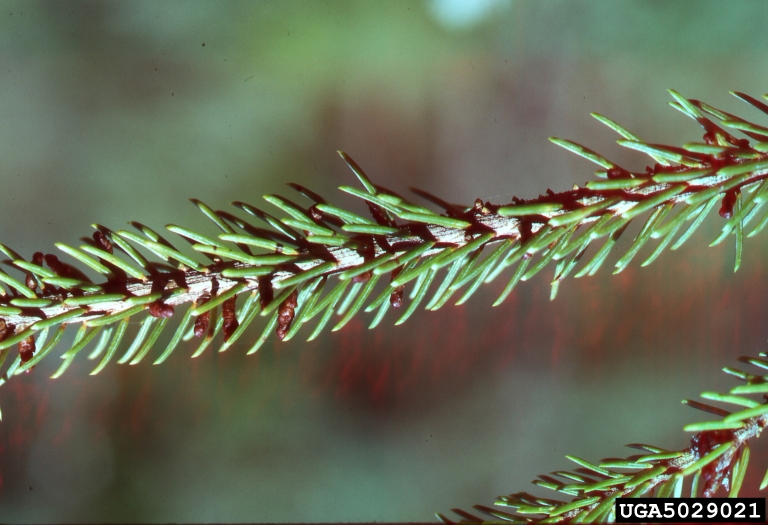 Although this organism cannot move it has developed an
extremely bizzare means of ensuring the spread of its seed.
When the seeds are ready for discharge they are forcefully
shot from the female plant using built up water pressure.
The seeds can reach distances of up to 55 ft (16.5m) and
obtain speeds of close to 55 mph. And if this wasn't
enough the seeds are coated in gooey sticky gel that allows
the seed to stick to anything that it may come into contact
with (i.e. another branch, a different tree, or even an
animal). But more on that under
Life History.
Although this organism cannot move it has developed an
extremely bizzare means of ensuring the spread of its seed.
When the seeds are ready for discharge they are forcefully
shot from the female plant using built up water pressure.
The seeds can reach distances of up to 55 ft (16.5m) and
obtain speeds of close to 55 mph. And if this wasn't
enough the seeds are coated in gooey sticky gel that allows
the seed to stick to anything that it may come into contact
with (i.e. another branch, a different tree, or even an
animal). But more on that under
Life History.